04/30/2026 - Qoheleth
I have a massive heap of information I've collected over the years. It began as a desire to understand why I should believe in God. It continued because as I grew in my faith, I felt compelled to share my beliefs with others. As a follower of Jesus, I felt a sense of obligation to be an effective communicator... a qoheleth of sorts.
The Hebrew word Qoheleth is derived from the root qahal (קהל), meaning "to gather or assemble." Linguistically, it implies a dual vocation:
- One who gathers things (knowledge, wisdom).
- One who gathers people in order to speak to them.
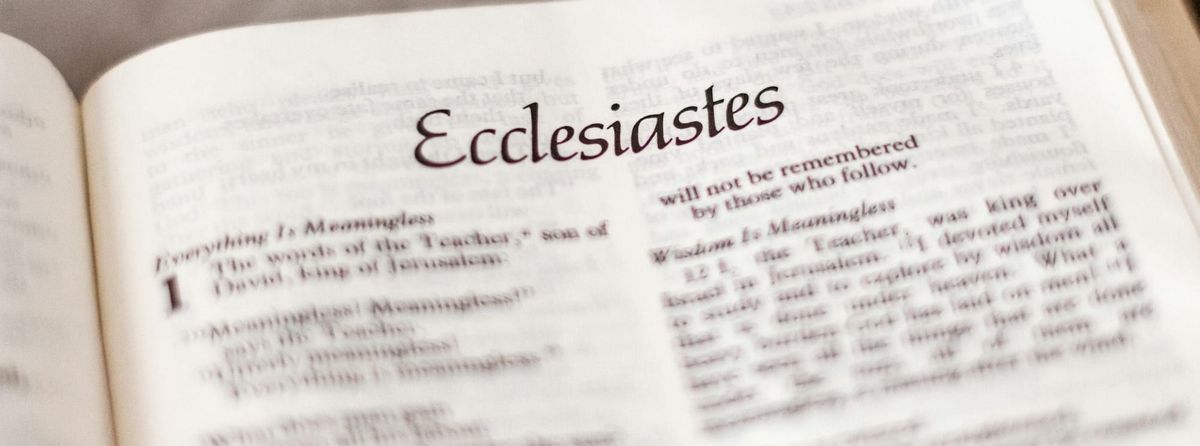
Qoheleth is not a popular word, but perhaps it should be. It is the original title of the biblical book commonly called Ecclesiastes.
How Qoheleth Became Ecclesiastes
In the 3rd century BC, Jewish scholars translated the Hebrew Bible into Greek (the Septuagint). When they encountered Qoheleth, they created the title Ekklēsiastēs, derived from the Greek word ekklesia (ἐκκλησία), the summoned assembly of citizens. When Saint Jerome produced the Latin Vulgate in the 4th century AD, he chose not to translate the word and instead transliterated it into Ecclesiastes.
In ancient Athens, an Ekklēsiastēs was a citizen who weighed various arguments before an assembly. Thus, the name reinforces the idea that the author isn’t just a speaker, but a curator. He assembles the disparate, often contradictory fragments of life—the "vanities" or "vapors"—into a single, challenging discourse for the community to hear.
Two Sides of the Human Vocation: Explore and Explain
The gatherer of ideas eventually becomes the gatherer of people. The Explorer must give way to the Explainer. These two activities are not merely correlated; they are codependent.
- The Gathering of Ideas (Internal Synthesis): Qoheleth "pondered and searched out and set in order many proverbs" (Ecclesiastes 12:9). This is the hard work of taking chaotic human experience and "gathering" it into a cohesive worldview.
- The Gathering of People (External Gravity): By "gathering" truth, the Qoheleth creates a gravity well. In the ancient world, the Qahal was summoned to prepare for war, offer worship, or share wisdom. Today, people still gather around those who have successfully distilled complexity into clarity.
Readers are Leaders
You've no doubt heard the phrase, "Readers are leaders." When an individual devotes time to the deep "gathering" of ideas, they are building a map of reality that is easier to grasp, more accurate, or more expansive than other maps.
Other people are naturally drawn to those who possess a better "map" during times of uncertainty. As a result, learning inevitably leads to leadership because the "leader" is the one who can articulate the terrain everyone else is currently trying to navigate. The leader performs the heavy lifting of processing reality’s complexity so that others don't have to.
People are not necessarily following the person; they are gravitating toward the most efficient map of the territory. The "Reader" becomes a "Leader" by providing a simplified linguistic interface that others can use to maneuver through their own complex lives.
The Epistemic Vapor
Throughout Ecclesiastes, the author:
- Gathers and examines observations: “I applied my mind to seek and to search out by wisdom…” (1:13).
- Presents his findings: “Hear the conclusion of the whole matter…” (12:13).
However, this exploration repeatedly collides with limitations. The author laments that "all is vapor" (hevel). While some translations use "meaningless," hevel implies something that can be perceived but not fully grasped... like a wisp of smoke that dissipates as soon as you reach for it. This is not nihilism. The author is expressing epistemic humility. It is the recognition that the gathering of data alone cannot yield ultimate meaning; the "heap" must be distilled.
The Arduous Journey: The Work of Forgetting
This task of reducing that heap of information reveals a wide and difficult gap between the act of knowing (exploring) and the act of telling (explaining).
Qoheleth begins his journey with the intake of everything: “I applied my heart to seek and to search out by wisdom all that is done under heaven” (1:13). This is the additive phase—the accumulation of the "massive heap." But by the end, he has whittled that mountain down to a single point: “Hear the conclusion of the whole matter…” (12:13).
Between these two bookends lies the most grueling work of cognition: the work of forgetting.
To translate exploration into explanation, one must perform a sort of intellectual surgery. Exploring is about adding; explaining is about subtracting. The "real work" isn't just remembering the facts but deciding which 90% of the information must be discarded so that the end receiver can perceive the 10% that contains the meaning.
As the text notes, “The Teacher searched to find just the right words” (12:10). This search is a struggle to bridge the gap by stripping away the noise of the "vapor" until only the "upright and true" remains.
The Qoheleth is not the person who simply shares every chunk of information they've discovered. The Qoheleth is the one who has the courage to decide what should be omitted. By removing the vast amounts of information that would otherwise drown the listener, the Qoheleth allows the "gathered" community to finally see the terrain for what it is.
If knowing is a private luxury, then telling is a public sacrifice.
